Innovation Killers: Recognizing and Overcoming Barriers (innovation series 6/6)

Pursuing innovation can propel an organization forward — but certain pitfalls stifle the creative process. Recognizing these "innovation killers" is key to a thriving culture of continual improvement.

Common Innovation Killers to Avoid

1. Having a legacy mindset over a beginner’s mindset. A legacy mindset is about how we did this before; it is the way things have always been done, rooted in the past rather than what’s possible.  Also, if you are an expert in a subject and think you have seen the problem before, you may be tempted to decide quickly.  There are limits if a problem has never been encountered before.  It is important to enlist beginners to see how they would approach it to get fresh ideas and see potential, whereas some experts may only see obstacles.

2. Sticking to your best ideas for too long.  Attachment to current successes can prevent new triumphs.  You want to be willing to let go of your best ideas so something new can emerge.  The iPhone rendered the iPod irrelevant, which was one of their best sellers, and that allowed for their continued dominance.

3. Saying no too early.  Sometimes, engineers ask a legal team for something, and their first response is to say no to protect legal liability, but they need to balance business needs and innovation. Functions like legal, compliance, and security can move faster and avoid blocking questions such as stating why certain things can’t be done.  Instead of saying no, you can say, here are our constraints; come back to me with three other ideas that you have considering these constraints.  Saying why we cannot do this instead of saying what other ideas you have thought about is more helpful.

4. Running with the first idea without proper evaluation. Sometimes, teams get together, spend time iterating, and choose the idea that makes some progress. This is done without even evaluating how good the idea is. Solutions are chosen way too early; we need time for innovation. 

5. Avoid Idea Robbing.  Sometimes, during idea generation, people take credit for others’ ideas, which calls the process into question.  People feel undervalued and frustrated. Give credit along the way to the person who came up with the idea and the ones who executed and delivered it.  It should promote idea ownership.

6. Leading with your Ego.  Some people will share an idea and will really want it to win even though it may not be the best. They want to get all the credit, and instead of thinking about what’s best for the team, they think about what’s best for them and their careers.  It is better to follow Ray Dalio’s process of idea meritocracy.  It does not matter who you are or what your title is; he is more interested in the best ideas moving forward.

7. Inefficient process.  If you don’t have steps, and timing, and a clear structure and process, people will get frustrated because they won’t know what they should be doing when.  Determine in advance the process: which phase is just for ideation, which phase is for decision. Who is the tiebreaker, or what is the process for escalation when there is an impasse, so we don’t have analysis paralysis on any one idea.

8. Innovation theater. Entrepreneur and Stanford lecturer Steve Blank coined this term for innovation activity — hackathons, labs, sticky-note workshops — with little real business outcome. Tells include: no decision-maker in the room who can greenlight a pilot; no kill criteria, so every idea survives; an annual cadence disconnected from real operations; and success measured in ideas generated rather than shipped. The fix doesn't need a bigger budget — it needs real authority in the room and the same discipline you'd apply to any other investment.

Innovation isn’t merely about generating ideas; it's also about fostering the right conditions for those ideas to flourish. By steering clear of innovation killers, we can create an ecosystem where creativity is cultivated, and the best ideas can thrive.

Quote of the day. "If you always do what you always did, you will always get what you always got." – Albert Einstein. 

Reflection Question.  What have you observed to be an innovation killer on any of the teams you worked on? Comment and share below; we would love to hear from you.

As a leadership development and executive coach, I work with leaders to cultivate a culture of innovation, contact me to explore this topic further.

Are you aware of team tendencies that halt innovation?

Harnessing The Power of Tools for Trailblazing Innovation (Innovation series 5/6)

Innovation thrives on fresh perspectives and challenging conventional thinking. A toolkit of diverse methodologies sharpens critical thinking, uncovers hidden opportunities, and reshapes strategy.

Let’s review a few helpful tools:

Analytical Techniques: These break a plan or strategy down to its underlying assumptions and pressure-test them before you commit.

1A. Assumptions testing.  A technique for identifying and challenging the stated and unstated assumptions a plan or strategy is based on.  The method is to review the statements and ask about the underlying assumptions. 

1B. The PESTLE tool.  Aims to expand your outlook.  It guides you to consider varied impacts - political, economic, social, technical, legal, and environmental – ensuring a well-rounded strategy.

2. Imaginative techniques.  They examine how plans could fail and then make interventions to ensure their success.  They help us imagine how different stakeholders view situations, so we don't use a narrow view or look through one lens. They help us look ahead and see the different ways a situation can play out.

2A. Premortem. Once an idea is agreed upon, ask: if this fails, what does that failure look like?  You can work backward and fix potential problems you identify that could lead to failure.  Then you can modify your strategy to reduce the likelihood they happen.  You can also list them, so you know to apply the brakes and ask questions about continuing down the same path if you see them occurring.  How do you want to proceed if you do not get the promised resources and sponsorship?  Spending time upfront on how the plan can fail can go a long way toward preventing that failure.

2B. 20 ideas method.  Begin by aiming for quantity over quality.  In the end, synthesize the ordinary and ridiculous ideas to develop a good one. Resist the temptation to fall in love with a solution early in the process; instead, practice psychological safety and good listening skills.  This process helps us move past our first ideas, which are usually not our best. Peter Skillman, Head of Connected Care at Philips, said that multiple iterations almost always beat a single-minded commitment to building your first idea.

2C. Gaining support for wild ideas. Encourage out-of-the-box thinking by creating an environment where even the most audacious ideas receive constructive feedback. It’s about nurturing ideas with the potential to disrupt.  If you have a crazy idea, try to get support from colleagues who will build on it or ask clarifying questions rather than tearing it down.

2D. Extreme brainstorming.  This concept comes from a Smart Bear article and is meant to spark new and better ideas.  It uses the premise that no idea is bad.  These prompts are meant to jolt you out of tiny thinking.  It stretches some dimension of reality to an extreme, so extreme that it is nearly nonsense.  The goal is that dramatically different perspectives can reveal distinctly new ideas.

·      10x Prices. If we had to increase our prices by 10x, what would you do to justify it?

·      No Customers. What would we do if all our customers vanished and we had to earn our growth and brand from scratch?

·      No Tech Support. What would have to change if you were never allowed to provide tech support?

·      Maximize Fun. What would be the most fun thing to build?

·      Complete rip-off.  If our biggest competitor copied every feature we have, how would we still win?

·      No Time. What if we are forced to ship a full, completed MVP new feature, in just two weeks, that would delight and surprise some fraction of our customers?

·      Flipped Business Model. What if you were forced to charge customers in a completely different manner? The product isn’t free, but somehow, you have to justify value (and costs) differently. If you’re usage-based, you’re forced to charge a flat monthly rate; if monthly with tiers, you’re forced to measure and charge daily with some formula.

·      No Website. How would you still grow your business if you were not allowed a website?

·      No Meetings. What if you made your most introverted teammates’ dreams come true: No more synchronous meetings, ever again?

·      No Customer Contact. How would we figure out what to build if we could never talk to our customers again?

·      Cost is No Object. What if it didn’t matter how unprofitable you were?

·      Sociopathic CEO. What if you could change anything, regardless of what anyone thinks or feels?

·      Mortal Wound. What externality could kill the entire company?

·      Philanthropist. What if our only goal were to create the most good in the world, personally for our customers?

·      Only One Thing This Year.  What if you could only ship one thing this year?

3. Contrarian techniques.  They stress-test strategies and plans to surface alternative perspectives.

3A. Appoint a rotating Devil’s Advocate in critical meetings. Inject intentional disagreement to see all sides.  The same person does not have to have this role; you can rotate the position so the hard work does not fall on one person's shoulders, and you can see different approaches to this position.   Design as if you are right and test as if you are wrong.

4. Reflection Tools.   Are meant to allow space for thinking about how things can go or for looking back and evaluating how they went and what to do differently, so there is always an aspect of learning.

4A. Reflect. Envision the future by imagining exciting possibilities.

·      Determine what you care about as a company and team, what drives you, and where your passions lie.

·      Make a list of all the things your teams want to accomplish and ask yourself why.

·      Use your past experiences for understanding themes in your company’s history, and what you find worthwhile.

·      Be curious about what is happening around you, especially things that are not going well.

4B. Conduct AAR (After Action Review) built into every experience.  What was supposed to happen, what did happen, why was there a difference, and what can we learn from this?  The value comes from the discipline of systematic learning. Solutions emerge when you take time for learning and reflection, rearrange thoughts, and generate new insights.

Innovation is less about a single eureka moment and more about consistently applying diverse tools that stretch, challenge, and refine our ideas. Integrating these tools into your process will pave the way for pioneering breakthroughs and robust strategies.

Quote of the day.  "Innovation is the unrelenting drive to break the status quo and develop anew where few have dared to go.” – Steven Jeffes.

Reflection Question.  What are some of the best techniques you have used with success?  Comment and share below; we would love to hear from you.

As a leadership development and executive coach, I work with leaders to cultivate a culture of innovation, contact me to explore this topic further.

The next article in this series (6/6) will focus on innovation killers and ways to overcome those barriers.

What are your favorite innovative techniques?

Structuring Your Team’s Innovation Process: Steps for Success (Innovation series 4/6)

Embarking on an innovation journey can be daunting, and many teams don't know where to start. This guide demystifies the process and provides a structured path from ideation to execution.

Planning Your Innovation Journey

1. Set goals and outcomes. To get the most productivity and creativity, you want to define the goal.  What are you trying to achieve?  Is the goal to generate a breadth of ideas in response to the problem statement you already defined or to go deep on a single concept to advance? Once you have a draft, you can collaborate with a small group of people to make sure you have not missed anything.  It is also helpful to provide the timing for your innovation sessions and the specific purpose.  Maybe for 2 hours, it is just about generating ideas.  Select a skilled facilitator to keep the team focused and on track.  When somebody is trying to get ahead in the process by zooming in on one idea to flesh out, the facilitator can jump in and return the conversation to the original intent, which is to generate ideas.  Take time to define success and provide what will be different at the end of the session. There should be a clear deliverable or outcome, e.g., we will get to 20+ ideas.

2. Establish norms that create a safe space: share freely, build on others' ideas (don’t reject any), keep moving (no analysis paralysis), be open-minded and judgment-free, enjoy the process.   A simple keyword can be a gentle reminder to adhere to these norms.  For example, if somebody offers an idea and another person says, “that won’t work,” anybody can say the word “norms” as a reminder to follow the process.

Ideation: Unleashing Creativity

1. The power of questions. Start with the expansive ‘How Might We’ question to open a world of possibilities. Go for questions that allow for multiple solutions such as, how can we improve our onboarding versus how can we improve our onboarding process to get resilient people.  You do not want the solution contained in the question.  Keep it open to invite curiosity.  If you only have a few ideas, you can broaden the question to include: How can we improve our organizational culture?

2.  Matching Medium to Message.  Leo Chan, Innovation Instructor, talks about leveraging different formats like sticky notes for brevity, idea cards for detail, and posters for comprehensive exploration.   

2A. Sticky Notes - Meant to capture 1-2 sentences and offer quick thoughts to get the topic going.

2B. Idea Cards – Legal-size paper that has a template requesting certain information such as:

·      Name of the idea so it is memorable.

·      A description of the idea so that if somebody was not in your meeting, they should know this key information.   

·      Drawing – a method to communicate even more information.  On the back of the card, you can put the creator on it instead of next to the idea because sometimes people vote for a person more than they do an idea. 

2C. Idea Poster – 30 minutes to fully bake an idea on a poster-size paper that has a few sections:

·      What’s the idea called?

·      What are the key features?

·      What’s the big idea (1-2 sentence summary of the entire thing, elevator pitch).

·      How does it work (draw)?

·      Consider why it might fail.

· How can I prototype or test it?

·      How might we measure success?

·      What’s our budget?

·      What’s our timeline for this?

3. Use a range of ideation techniques. This allows you to explore possibilities and push boundaries. Here are a few techniques offered by Leo Chan, plus one worth adding to the toolkit:

3A. What if.  An exercise in challenging existing rules and flipping them on their heads to discover unexpected opportunities. 

3B. Photo Serendipity. The use of visual stimuli to inspire fresh ideas by engaging the senses.  

3C. Worst idea ever.  Intentionally think of the worst ideas to overcome creative blocks and then invert them to uncover viable solutions.

3D. Mind mapping – This is a great way to come up with ideas and let your mind wander.  In the middle of the page, you would circle the idea or question, such as onboarding or how we improve our onboarding.  Then you add many idea stickies around the topic with related ideas and categories to encourage lateral thinking.

3E. AI-assisted ideation.  Mattel's product team has used generative AI in Hot Wheels development to generate roughly four times as many product concepts as its previous process — not replacing designers' judgment, but widening the raw material they evaluate. Used this way, AI plays the role of a fast, high-volume sticky-note storm before the team applies human judgment to converge. The risk: treating AI-generated volume as a substitute for that evaluation step, rather than an input to it.

Evaluating Ideas

Once you have spent time planning and ideating, you want to narrow, focus, and evaluate the ideas to focus on the best to develop further. Here are some tools for that:

1. Like, dislike, opportunity. Color-coded sticky notes (green/red/blue) make group reactions visible at a glance.

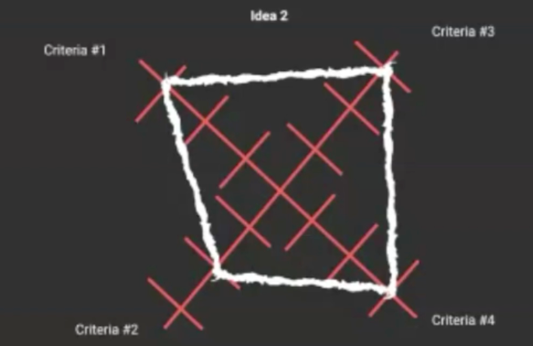
2. Polygon map. Leo Chan introduced this process called the Polygon map.  This is a way to score ideas against key criteria to assess their viability and breadth. For an idea to move forward, it has to get certain points on each criterion. For example, if you are considering a feature, maybe the criteria could be increasing customer base, revenue, NPS, etc. The wider the circle, the more robust the idea.

What’s your process for innovation?

3. Anonymous feedback collects candid input focused on the idea's merit, not the messenger.

4. Voting committees present ideas to an impartial group for objective selection.

Innovation doesn't happen by chance — it's a deliberate process of planning, ideation, and evaluation. Following this guide gives it both direction and purpose.

Quote of the Day. "There's a way to do it better — find it." — Thomas Edison

Reflection Question. What's your team's innovation process, and where have you found success?  Comment and show below, we’d love to hear from you!

As an executive, leadership, and team coach, I work with leaders to cultivate a culture of innovation. Contact me to explore this topic further.

The next article in this series (5/6) reviews the tools that sharpen innovative thinking.

Cultivating Innovation: Carving Out Time for Deliberate Thought (innovation series 3/6)

In a landscape dominated by immediate tasks, innovation is often sidelined. Balancing today's demands with tomorrow's vision requires intentional thinking time—not working harder, but smarter —with room for contemplation so you're moving forward, not just active.

What to Do During Dedicated Think Time

1. Reassess mission, vision, and values. Periodically question how they continue — or fail — to meet customer needs, and where innovation could strengthen alignment.

2. Catalog problems.   What are the enduring problems that never seem to get solved?  If you mapped out each function's top three pain points, where would patterns and themes emerge?  This can guide where innovation is most needed.

3. Learn. What's your process for taking in new ideas — reading, podcasts, research? Organizational researcher Bob Sutton has argued generalist-run companies out-innovate specialist-run ones; Mary Barra held roles across manufacturing, HR, and product development before becoming GM's CEO. David Epstein's Range found the same pattern in athletes who sampled widely before specializing. New in 2026: AI tools like Claude can dramatically compress the research phase of learning, freeing up more time for the reflection only a human can do.

4. Look outside your field. This approach can spark ideas for new products, processes, and services.  The solution to an accounting problem could be found in taking up jazz guitar.  A solution to a coding puzzle could be in a food documentary on Netflix.  Engineering and birdwatching may have more in common than you know.  Research shows innovation can come from just about anywhere.

5. Look inside your company. Talk to your customers, lead users, suppliers, business partners, and R&D labs.  Leaders should wander around, ask questions, and then connect the dots of disparate information in valuable and essential ways.  Only by forcing yourself to break free from pre-existing views can you re-categorize information and move beyond habitual thinking patterns.  Without this, you will gravitate toward the routine.

6. Take on stretch projects at least once a quarter or year to accelerate your own learning curve.

7. Upgrade capabilities continuously — people can't deliver on what they don't know how to do.

8. Embrace downtime. When you do nothing, your mind wanders, thinks, and innovates.  Walking, biking, playing music, meditating, and being in nature are all helpful.  Albert Einstein reportedly said that he did nothing 99% of the time, and ideas came to him.  Rest is often the source of great ideas, not their enemy.

Team Strategies for Innovation

1. Perspective-taking. Spend time talking to innovation teams and customers.  Bracken Darrell, CEO of Logitech, spends 40-60% of his time on innovation in conversation with others because he believes this aspect can’t be outsourced.  As a team, it’s helpful to discuss: Who are all the stakeholders involved?  What are their perspectives now?  What were their perspectives previously?  What prompted the shift?  What could their perspectives be in the future?  Why would it be different?  You can invite customers, suppliers, people from other departments, and other outsiders to your meetings to offer suggestions for improving your department. 

2. Schedule white space. You run on fumes when you go from meeting to meeting or activity to activity. When your team makes it the norm to build in an empty block or buffer between meetings, or a free morning to do nothing, ideas will visit you, and you'll have time to capture and play with them. If you don't have white space, or your teammates don't respect it, ideas will go elsewhere.

3. Incentivize innovation. When top leadership tells middle management to innovate but then incentivizes and rewards them based on revenue from current products, it sends a mixed message. You can tie innovation to the career framework. If team members participate in innovation and drive bold alternative solutions, recognize it. 

4. Allocate deep work time. Set aside time to focus, think deeply about one thing or survey the landscape, let your thoughts drift, and see what comes up.  Regular, undisturbed intervals can spark creativity and lead to substantial breakthroughs.

4A. Reflection time.  A space to regularly ask: what’s working, what’s not, what should we do differently, and what have we never tried before? 

4B. Vision work.  What is the long-term vision for your company?  What are some ideas that change the course of history, like putting a man on the moon or what Safi Bacall would call a Loonshot.  

·      Practice idealization, a proven method of peak performance thinking.  Asking questions such as, if you could wave a magic wand and make your business different today, what would it look like, and what would be the first step to get to where you have to go. 

·      What one great thing would you want to dream if you knew you could not fail?

4C. Goal setting.  What are the three most important goals for business, culture, growth, and leadership for next year, and the following three?  It may change, but engaging in the work can spark ideas.

5. Allocate meeting time for innovation. Devote a percentage of time in every staff meeting, or every other meeting, to listening to outside ideas for improving processes and tech and developing new products and services.

5A. Bring diverse groups together from the beginning.  Safi Bacall talks about the importance of bringing two types of people together in the organization: the creators/artists who come up with new ideas and work on the product, and the soldiers who execute the product.  A skilled facilitator is essential because artists are prone to take risks, and it can sting when they share ideas they've poured their soul into.  Soldiers are wired to take little risks. Steve Jobs had Johnny Ive, a legendary product guy/artist, and Tim Cook, head of inventory/soldier, balance each other out.  When Jobs reflected on his life, he said the most innovative thing he did was design his organization.  People bring their own mental models and frameworks; with that diversity, great ideas emerge when you have an effective process.

6. Dedicate innovation days, weeks, or teams.

6A. Dedicated Innovation Days – Google’s 20% time lets people spend 20% of their work hours, or one day a week, working on projects of their choice unrelated to their regular job responsibilities.  This freedom allows employees to explore their passions, experiment with new ideas, and collaborate with colleagues across the organization.  This innovation time has led to the company’s most successful products: Gmail, Google News, and Google Maps.

6B. Hack Week – Time for creatives to get together, iterate, and plan.  Spotify’s beloved Discover Weekly playlist originated as a Hack Week idea, as did the ability to exclude select playlists from your taste profile.

6C. Innovation Labs– Teams directly responsible for innovation. Google X’s lab has been responsible for Google Glass, Google driverless cars, and many more.  Amazon Lab126 focused on the reinvention of the book and, as a result, produced the Kindle, Amazon Echo, Alexa, and Fire Stick TV

7. Use sentence stems with your team.  You can have innovation meetings and do exercises such as sentence stems to spur thinking.  For example:

·      Could our product be put to a different use?

·      Could we adapt or copy what somebody else is doing to improve the product?  Taking an innovation from one industry and applying it to another is helpful.   Henry Ford got the idea for the production line by watching a meat-processing plant.

·      Could we modify, change, or repackage our idea?  Walt Disney saw that fairs were trashy and wanted to create a clean amusement park.

·      Can we magnify the product by making it bigger or shinier?

·      Could we minimize it, making it shorter or subtracting from it?

·      How about a substitute? Can we use a different manufacturer, material, or advertising approach?

·      Can we make our products more attractive and sellable?

·      Can we reverse our thinking and take an opposite approach to what we are doing?

·      Can we combine the product with something else, and can we bundle it to have a higher offering?  Can we find value in a byproduct?

·      How can we provide a superior buying experience to the competitor? Let’s identify three ways that can make our product more attractive.

Making time for innovation isn't a luxury; it's a necessity for growth.  By institutionalizing practices that foster reflective thinking and creative exploration, we pave the way for meaningful innovations that can redefine the market landscape.

Quote of the day. “Think left and think right, think low and think high. Oh, the things you can think up if only you try!” -Dr. Seuss

Reflection Question.  What are your reflection practices connected to innovation?  Comment and share below; we would love to hear from you.

As a leadership development and executive coach, I work with leaders to cultivate a culture of innovation, contact me to explore this topic further.

The next article in this series (4/6) will focus on the importance of defining the problem for greater innovation


What time do you spend on innovation?

Innovation Begins with Better Problem-Defining (Innovation series 2/6)

Unlocking innovation starts with a clear understanding of the problem. Without a unified grasp of organizational identity and goals, companies risk the high failure rates seen in business transformations—a disconnection that ripples from executives to frontline managers, creating inefficiency and missed opportunities. Clarity enables focused, effective problem-solving.

Challenges with Defining a Problem

1. Premature solutioning. Teams gravitate toward the first feasible solution without exploring better options.  Time constraints and high-activity environments can lead to poorly orchestrated planning sessions, risking solutions to ill-defined problems.

2. Varied definitions. A problem looks different through engineering, sales, and product lenses, creating interdepartmental misunderstandings.

3. Collaboration hurdles. The thorniest problems need many cross-functional partners, but the person leading the charge often gets the credit while contributors get overlooked.  These recognition imbalances discourage some from giving full effort next time.

A Model for Defining a Problem: The 5 Whys

The 5 Whys is a simple, powerful tool that moves past outward symptoms to a problem's underlying cause, so you can address it once and for all. Toyota refined the method as a core part of its problem-solving training. Sakichi Toyoda, architect of the Toyota Production System, described it as "the basis of Toyota's scientific approach . . . by repeating why five times, the nature of the problem as well as its solution becomes clear." The lineage traces back to Socrates, who probed people's arguments with repeated "why" until they were forced to examine their own assumptions — the Socratic method.

Here's how it can look:

•    A new release broke a key feature. Why? A server failed.

•    Why did the server fail? An obscure subsystem was misused.

•    Why was it misused? The engineer didn't know how to use it properly.

•    Why didn't he know? He was never trained.

•    Why wasn't he trained? His manager doesn't believe in training new engineers because they're "too busy."

A purely technical fault turns out to be a managerial one. You can fix the server, make the subsystem less error-prone, train the engineer, and address the manager's belief — a proportional investment at each level. In other words, fix the server, make the subsystem less error-prone, train the engineer, and talk with the manager.

Five is just a number; ask why as many times as you need, but not so many that you drift into unrelated complaints.

Advantages and Downsides

•    Advantages: offers a structured approach; isn't about blame but root cause; democratizes problem-solving; builds a culture of continuous improvement.

•    Downsides: won't work if the cause is genuinely unknown; assumes a single cause when causes are often jointly sufficient; one weak answer can throw off the whole chain; results vary between users.

A Complementary Tool: Reframing

The 5 Whys drills into a known problem well — but what if the problem was misdiagnosed from the start? That's Thomas Wedell-Wedellsborg's focus in What's Your Problem? His finding: leaders routinely solve the wrong problem well, because they fall in love with an initial framing before testing it. His reframing practice: state the problem in one sentence, seek an outsider's view, look for exceptions where the problem doesn't occur, check who actually owns it, and ask what's missing from the definition. Reframe first to make sure you're drilling into the right problem, then apply the 5 Whys.

Process for Defining and Validating Problems

1. Define separately. Gather each department's closest people and run a 5 Whys exercise to produce their own statement.

2. Reconcile. The next stage is to create alignment. If definitions already overlap, great. Otherwise, combine all the problem statements and spend time on one collective definition that encompasses different voices, because each group thinks about the problem differently, through their own lens and expertise. Even if the final version doesn't satisfy everyone, as long as everyone can weigh in and the majority rules, that’s enough. This co-creation process can be messy, but with the right group norms and facilitator, it can be effective.

3. Create buy-in. Some problems have plagued companies for years, and they are so big they outweigh any one individual or team.  Instead of one person taking all the credit, frame it as a collective opportunity for the team to get recognition, rather than one person leading the charge. 

4. Validate. Once you have the problem statement, spend time with your stakeholders (senior leaders, partners, customers) to get their opinions, confirm it is the right problem, and assess the value it will deliver once solved.    

5. Evaluate readiness. Review the team's capability to execute. People often suggest ideas based on their existing skillset rather than the best approach — bring in the right resources, or the team will row hard without the muscle to reach the destination.

A well-defined problem is the foundation of innovation. Structured methods like the 5 Whys and reframing, paired with collaborative clarity, pave the way for impact.

Quote of the Day. "Always the beautiful answer who asks a more beautiful question." — E.E. Cummings

Reflection Question. What problem-solving techniques have proven effective for you and your organization? Comment and share below; we’d love to hear from you!

As an executive, leadership, and team coach, I work with leaders to cultivate a culture of innovation. Contact me to explore this topic further.

The next article in this series (3/6) looks at carving out dedicated time for the deliberate thought innovation requires.

What methods do you use to define a problem?

The Art of Invention: Cultivating a Culture of Innovation in Your Company (Innovation Series 1/6)

In today's fast-paced, AI-accelerated business environment, innovation is the currency for staying ahead. It drives new products and services, optimizes operations, and enhances customer experience — the edge companies need not just to lead, but to survive. The tools have never moved faster. The discipline required to use them well hasn't changed.

Defining Innovation Through Different Lenses

Innovation is defined in many ways. Steve Jobs described it as the ability to "see what everybody has seen and think what nobody has thought," intertwining simplicity with user experience. Elon Musk frames it as bold ventures into human progress — SpaceX, sustainable energy. Tim Brown of IDEO champions design thinking: a human-centered approach that keeps organizations focused on the people they're building for. And Satya Nadella's turnaround of Microsoft, replacing a "know-it-all" culture with a "learn-it-all" one, shows that a growth mindset at the top is itself an innovation strategy. Innovation transcends a single definition — it takes many forms of value creation.

Clayton Christensen's Three Types of Innovation

The late Harvard Business School professor Clayton Christensen — still among the most cited voices in management theory — outlined three types every leader should be able to name in their own organization:

1. Efficiency innovation improves your existing business model — better processes, management, value proposition. Amazon's warehouse robotics and AI are one example; each new iPhone is another. It matters, but on its own it's not enough — if the business model itself is going stale, efficiency just helps you decline more smoothly. Christensen's warning still holds: in a healthy economy, efficiency, sustaining, and empowering innovation stay in balance. Over-invest in efficiency alone and you starve the growth engines you'll need in five years.

2. Sustaining innovation upgrades and broadens an existing value proposition — think of how Kindle reshaped reading. It adapts and grows within the industry's current framework.

3. Empowering (market-creating) innovation — Christensen's own term, not "transformative," a common misnomer — takes something complicated and expensive and makes it simple and affordable enough for an entirely new population to access. The Ford Model T did this for the automobile; AWS did it for enterprise computing. Generative AI may be this decade's clearest example: capability that once required a data science team is now available through a chat window. Safi Bahcall's "loonshots" — ideas initially dismissed as absurd — capture this category at its most ambitious, from curing cancer to the moon landing.

Measuring Your Company's Innovation

To learn where your company is, try this with your leadership team: have each person write down five favorite innovations from the last three years, one per sticky note, then sort them into the three categories above. In my experience, a pattern shows up almost every time—most people believe they're generating market-creating ideas, but most of what lands on the board is sustaining work, with a large share of efficiency work wearing an innovation costume. That's not a failure; it's information. If most of what you call "innovation" is really optimization, and your industry is shifting beneath you, you risk executing the old model more efficiently until it stops mattering.

Innovation Challenges & a Model for Sustained Innovation

Most companies recognize innovation's importance; far fewer implement it well. The stakes are real: research firm Innosight has tracked a steady contraction in corporate lifespan for decades — the average S&P 500 tenure fell from roughly 33 years in 1965 to well under 15 today, with close to half of the current index projected to turn over within ten years. There's a 2026 twist, too: adoption isn't the same as maturity. McKinsey's 2025 State of AI survey found 88 percent of organizations now use AI in at least one function, yet only about 1 percent call their deployment mature. Many companies are using AI to improve efficiency right now without doing the sustaining or empowering work that would actually change their trajectory.

The 70:20:10 model, popularized by Google's approach to innovation investment, offers a balanced allocation: roughly 70 percent to optimizing the core, 20 percent to adjacent bets, 10 percent to genuinely transformative ones. Very few organizations actually hit that 10 percent — which is exactly why so few land in the empowering-innovation column.

Innovation is more than a buzzword; it's the heartbeat of business longevity. Embedding it deeply into your strategy — the kind of Lead for Impact work I do with executive teams — ensures your company doesn't just adapt, but thrives.

Quote of the Day. "Creativity is about pairing the familiar in novel ways, and the novel in familiar ways." — Karl Weick

Reflection Question. How does your company embrace innovation — and if you ran the sticky-note exercise above, where do you predict the ideas would land?

As an executive, leadership, and team coach, I work with leaders to cultivate a culture of innovation, contact me to explore this topic further.

The next article in this series (2/6) explores why innovation begins with better problem-defining.

How does your company innovate?