
Embarking on an innovation journey can be daunting, and many teams don't know where to start. This guide demystifies the process and provides a structured path from ideation to execution.
Planning Your Innovation Journey
1. Set goals and outcomes. To get the most productivity and creativity, you want to define the goal. What are you trying to achieve? Is the goal to generate a breadth of ideas in response to the problem statement you already defined or to go deep on a single concept to advance? Once you have a draft, you can collaborate with a small group of people to make sure you have not missed anything. It is also helpful to provide the timing for your innovation sessions and the specific purpose. Maybe for 2 hours, it is just about generating ideas. Select a skilled facilitator to keep the team focused and on track. When somebody is trying to get ahead in the process by zooming in on one idea to flesh out, the facilitator can jump in and return the conversation to the original intent, which is to generate ideas. Take time to define success and provide what will be different at the end of the session. There should be a clear deliverable or outcome, e.g., we will get to 20+ ideas.
2. Establish norms that create a safe space: share freely, build on others' ideas (don’t reject any), keep moving (no analysis paralysis), be open-minded and judgment-free, enjoy the process. A simple keyword can be a gentle reminder to adhere to these norms. For example, if somebody offers an idea and another person says, “that won’t work,” anybody can say the word “norms” as a reminder to follow the process.
Ideation: Unleashing Creativity
1. The power of questions. Start with the expansive ‘How Might We’ question to open a world of possibilities. Go for questions that allow for multiple solutions such as, how can we improve our onboarding versus how can we improve our onboarding process to get resilient people. You do not want the solution contained in the question. Keep it open to invite curiosity. If you only have a few ideas, you can broaden the question to include: How can we improve our organizational culture?
2. Matching Medium to Message. Leo Chan, Innovation Instructor, talks about leveraging different formats like sticky notes for brevity, idea cards for detail, and posters for comprehensive exploration.
2A. Sticky Notes - Meant to capture 1-2 sentences and offer quick thoughts to get the topic going.
2B. Idea Cards – Legal-size paper that has a template requesting certain information such as:
· Name of the idea so it is memorable.
· A description of the idea so that if somebody was not in your meeting, they should know this key information.
· Drawing – a method to communicate even more information. On the back of the card, you can put the creator on it instead of next to the idea because sometimes people vote for a person more than they do an idea.
2C. Idea Poster – 30 minutes to fully bake an idea on a poster-size paper that has a few sections:
· What’s the idea called?
· What are the key features?
· What’s the big idea (1-2 sentence summary of the entire thing, elevator pitch).
· How does it work (draw)?
· Consider why it might fail.
· How can I prototype or test it?
· How might we measure success?
· What’s our budget?
· What’s our timeline for this?
3. Use a range of ideation techniques. This allows you to explore possibilities and push boundaries. Here are a few techniques offered by Leo Chan, plus one worth adding to the toolkit:
3A. What if. An exercise in challenging existing rules and flipping them on their heads to discover unexpected opportunities.
3B. Photo Serendipity. The use of visual stimuli to inspire fresh ideas by engaging the senses.
3C. Worst idea ever. Intentionally think of the worst ideas to overcome creative blocks and then invert them to uncover viable solutions.
3D. Mind mapping – This is a great way to come up with ideas and let your mind wander. In the middle of the page, you would circle the idea or question, such as onboarding or how we improve our onboarding. Then you add many idea stickies around the topic with related ideas and categories to encourage lateral thinking.
3E. AI-assisted ideation. Mattel's product team has used generative AI in Hot Wheels development to generate roughly four times as many product concepts as its previous process — not replacing designers' judgment, but widening the raw material they evaluate. Used this way, AI plays the role of a fast, high-volume sticky-note storm before the team applies human judgment to converge. The risk: treating AI-generated volume as a substitute for that evaluation step, rather than an input to it.
Evaluating Ideas
Once you have spent time planning and ideating, you want to narrow, focus, and evaluate the ideas to focus on the best to develop further. Here are some tools for that:
1. Like, dislike, opportunity. Color-coded sticky notes (green/red/blue) make group reactions visible at a glance.
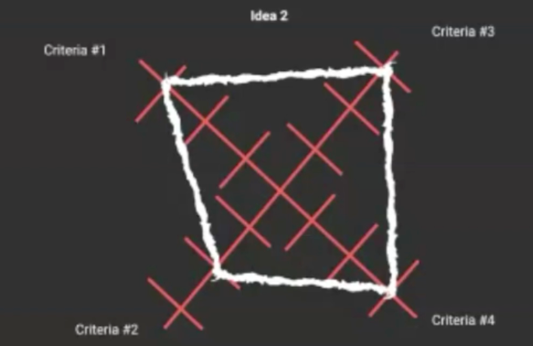
2. Polygon map. Leo Chan introduced this process called the Polygon map. This is a way to score ideas against key criteria to assess their viability and breadth. For an idea to move forward, it has to get certain points on each criterion. For example, if you are considering a feature, maybe the criteria could be increasing customer base, revenue, NPS, etc. The wider the circle, the more robust the idea.

What’s your process for innovation?
3. Anonymous feedback collects candid input focused on the idea's merit, not the messenger.
4. Voting committees present ideas to an impartial group for objective selection.
Innovation doesn't happen by chance — it's a deliberate process of planning, ideation, and evaluation. Following this guide gives it both direction and purpose.
Quote of the Day. "There's a way to do it better — find it." — Thomas Edison
Reflection Question. What's your team's innovation process, and where have you found success? Comment and show below, we’d love to hear from you!
As an executive, leadership, and team coach, I work with leaders to cultivate a culture of innovation. Contact me to explore this topic further.
The next article in this series (5/6) reviews the tools that sharpen innovative thinking.