
Not all office politics are created equal. Some workplaces run on transparency and trust; others feel like Game of Thrones, where whispers carry more weight than hard work.
In The Secret Handshake, Kathleen Kelley Reardon identifies four types of political cultures - from low-key to chaotic. Knowing where your organization falls on the spectrum is key to navigating and reshaping its political climate.
1. Minimally Political. What you see is what you get. Expectations are clear, success is based on merit, and politics are rare. There’s a strong sense of fairness, camaraderie, and trust. Patagonia is an example: you might design backpacks from the beach or pop into your kid’s daycare between meetings without worrying it will be seen as a lack of commitment or ambition.
2. Moderately Political. Most organizations land here. Official processes are followed, but informal tactics (like backchanneling or flattery) exist in the margins. Mixed messages are common- like rewarding visibility over real impact. For example, a company may promote collaboration but favor insiders or long-standing relationships when assigning high-profile projects. A university may celebrate great teaching but grant tenure based on publishing. Spoken values do not always match actual rewards.
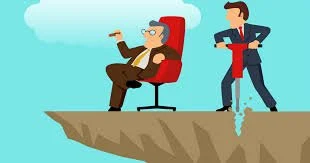
3. Highly Political. Politics are the norm. Rules bend for those in power and are applied inconsistently; power is hoarded, and alliances are everything. In-groups and out-groups are clear, and influence often trumps competence. Employees protect turf, manage impressions, and spend more time navigating power than doing the work.
Leadership transitions in these organizations can be especially political. When a new executive steps in, high-level reshuffling is common— trusted lieutenants are brought in, legacy leaders are let go, and new priorities quickly take shape. While often framed as “strategy alignment,” it’s also a clear political statement: loyalty and alignment with the new power center will shape who stays, who goes, and who rises. For employees, this is a moment to assess: Are you aligned with the new direction, or will you need to reposition yourself—or your role—to stay relevant?
4. Pathologically Political. In these organizations, politics is no longer a side game — it’s the main event. Conflict is constant, and distrust runs deep. Virtually every decision happens through unofficial channels, and formal processes are bypassed for survival. Work slows down, collaboration disintegrates, and morale tanks. People focus more on self-protection than innovation. Talent flees. Burnout sets in. And organizational performance is not optimized.
How Organizations Can Reduce Toxic Politics
Politics may be inevitable, but dysfunction is not. Here’s how leaders can build healthier cultures:
1. Normalize “Straight Talk.” At IBM, former CEO Lou Gerstner introduced “straight talk” as a cultural norm. Any employee - even the most junior - could preface feedback with “In the spirit of straight talk…” and leaders were expected to listen. It created space for honesty over ambiguity, and directness over coded communication.
2. Reward Idea Sharing, Not Hoarding. Jack Welch of GE famously refused to reward people who saved their best ideas for senior leader meetings. His rule was: If you hadn't already shared your idea with others, don’t bother bringing it to him. This discouraged political showboating and encouraged open, cross-level collaboration.
3. Align Values with Rewards. Toxic politics often grows in the gap between what organizations say they value and what they actually reward. If you claim to value collaboration but only promote lone wolves, your culture will breed cynicism. Close the gap. Align performance metrics, recognition, and advancement with your stated values.
4. Map the Network, Not Just the Org Chart. More HR and leadership teams now use organizational network analysis (ONA) to see how information and influence actually flow, not how they’re supposed to flow on paper. This surfaces informal influencers, information hoarders, and people who are quietly isolated—often the very employees proximity bias leaves behind. You cannot fix what you can’t see; mapping the real network makes invisible inequities visible.
5. Track Power Dynamics. High-trust organizations do not happen by accident. Leaders need to pay attention to how influence is used—who’s gaining it, how it’s wielded, and whether it serves the greater good. Ask yourself: are we rewarding impact, or just visibility? Are we growing leadership or just nurturing loyalty?
Office politics will never disappear entirely. When influence is used ethically, it can powerfully move things forward. But when politics run unchecked, even the best people can get stuck, burn out, or be driven out.
Knowing your organization’s political DNA - and having the courage to name it - is the first step toward creating a culture where influence doesn’t come at the cost of integrity.
Quote of the day. "The culture of any organization is shaped by the worst behavior the leader is willing to tolerate." -Gruenert & Whitaker
Reflection Question. Where does your organization fall on the political spectrum -and how is that impacting your ability to lead, contribute, and grow? Comment and share below; we’d love to hear from you.
The next article in the series 3/3 will explore strategies for navigating politics.
As a leadership development and executive coach, I work with leaders to better navigate office politics, contact me to explore this topic further.
How do politics show up in your workplace?