
Confidence is a leadership asset. Left unchecked, it quietly becomes something else — and the shift is rarely visible to the person making it.
Confidence is essential to leadership. Leaders are expected to make decisions, set direction, and communicate a clear point of view. Teams look to them for conviction — especially when navigating uncertainty, change, or competing priorities. Confidence signals competence. It establishes credibility. It gives people something to orient around when the path isn't obvious.
And yet, like most leadership strengths, confidence has a shadow side. What begins as earned self-assurance can gradually evolve into something more limiting — not in a single dramatic moment, but in the slow accumulation of small patterns that eventually shape how a leader learns, listens, and decides. The issue is not confidence. The issue is when confidence hardens into arrogance: the assumption that your perspective is already correct before you've fully heard anyone else's.
When that shift occurs, the consequences aren't just interpersonal. They're organizational. Leaders stop testing assumptions as rigorously. Input narrows. Challenges get minimized. And the organization receives a less accurate picture of what's actually true — precisely when it needs that picture most.
The Subtle Shift
Arrogance rarely arrives suddenly. It tends to develop after a run of success — which is part of what makes it so difficult to catch. Jim Collins, in his research on organizational decline, identified what he called "hubris born of success": a pattern in which leaders who have been right many times begin to assume they will continue to be right — and stop doing the work of checking.
The leader's experience becomes not just a guide, but a verdict. Their intuition substitutes for inquiry. Their track record becomes a reason to stop questioning, not a foundation to build on. And the people around them — sensing the shift, even if it's never named — begin to self-censor.
How Arrogance Actually Shows Up
It rarely looks like overt ego or loud bravado. In high-performing leaders, it often shows up in subtler patterns that shape interactions over time. Amy Edmondson's research is instructive here: when leaders consistently signal that they already know the answer, team members become significantly less likely to raise concerns, challenge assumptions, or surface the early signals that could change the outcome. Information flow narrows—not because people lack useful perspectives, but because they've learned not to offer them.
Arrogance often looks like:
• Speaking with certainty before hearing other perspectives — signaling the conclusion before the conversation has begun
• Absorbing others' ideas and reframing them as refinements of your own
• Dismissing dissent too quickly — not with hostility, but with confidence
• Explaining rather than inquiring, even in situations where the leader doesn't have full context
• Assuming that experience and pattern-recognition outweigh fresh perspective
None of these are dramatic. All of them accumulate. Over time, they don't just affect how the leader is perceived—they affect what the leader actually knows and how well the organization performs.
What This Looks Like in Practice
An executive team is reviewing early results from a major initiative. The data shows meaningful challenges in several markets. A senior leader who championed the initiative speaks quickly: the issues are temporary, the strategy is sound, the team needs to stay the course.
Operating from arrogance: The discussion closes early. Concerns get minimized. Others in the room — who may have been tracking signals for weeks — sense that questioning the strategy won't be welcomed. The leader leaves believing they've provided steadiness. The team leaves carrying questions they couldn't ask.
Operating with confident humility: The leader says: "These results aren't what we expected. What are we learning from the markets that are struggling?" The tone shifts. The team examines the data more closely, surfaces what they've been observing, and adjusts the strategy accordingly. The leader's credibility grows — because they demonstrated confidence without closing the door to new information.
The Distinction That Matters
Edgar Schein captured this distinction in his concept of humble inquiry — the practice of asking genuine questions from a place of authentic curiosity, rather than questions designed to steer toward a predetermined answer. Leaders who adopt this approach create better information flow, stronger relationships, and more effective decisions. Not because they're less confident, but because they pair their confidence with genuine openness.
The most precise way to describe the difference:
• Confident leaders believe in their perspective — and remain genuinely curious about what they might be missing
• Arrogant leaders assume their perspective is already the best available — and engage with others primarily to confirm it
Confidence establishes direction. Humility keeps learning alive. Together, they create durable, high-trust executive leadership.
Practices for Confident Humility
These behaviors are simple. They require practice to become consistent.
• Invite challenge directly: "What risks or blind spots might we be missing here?"
• When a colleague's input strengthens the outcome, name it — in the room, not just privately
• Maintain a small group of trusted advisors who will tell you the truth, and create explicit permission for them to do so
• When new information emerges that contradicts your position, adjust publicly — and without defensiveness
• Distinguish between conviction (which should be high) and certainty (which should remain proportional to what you actually know)
Leaders who practice these habits send a signal that strength and humility are not opposites. They reinforce one another. Organizations led by people who hold both tend to make better decisions, surface problems earlier, and build the kind of trust that sustains performance through difficulty.
Reflection Question. Where in your leadership might confidence be unintentionally limiting your openness to other perspectives? Comment and share below; I’d love to hear your perspective.
Quote of the Day. Real knowledge is to know the extent of one's ignorance. — Confucius
As an executive leadership coach, I work with leaders to become more effective. Often that means helping them recognize subtle habits that once fueled their success but now quietly limit their impact. If you’d like to explore this topic further, feel free to reach out.
The final blog in this series (4/4) will explore another leadership limitation: emotional instability, and how leaders can regulate emotions to strengthen trust and presence.
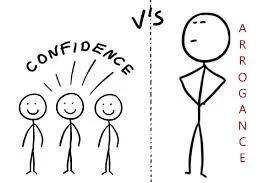
How does your confidence & arrogance show up?